

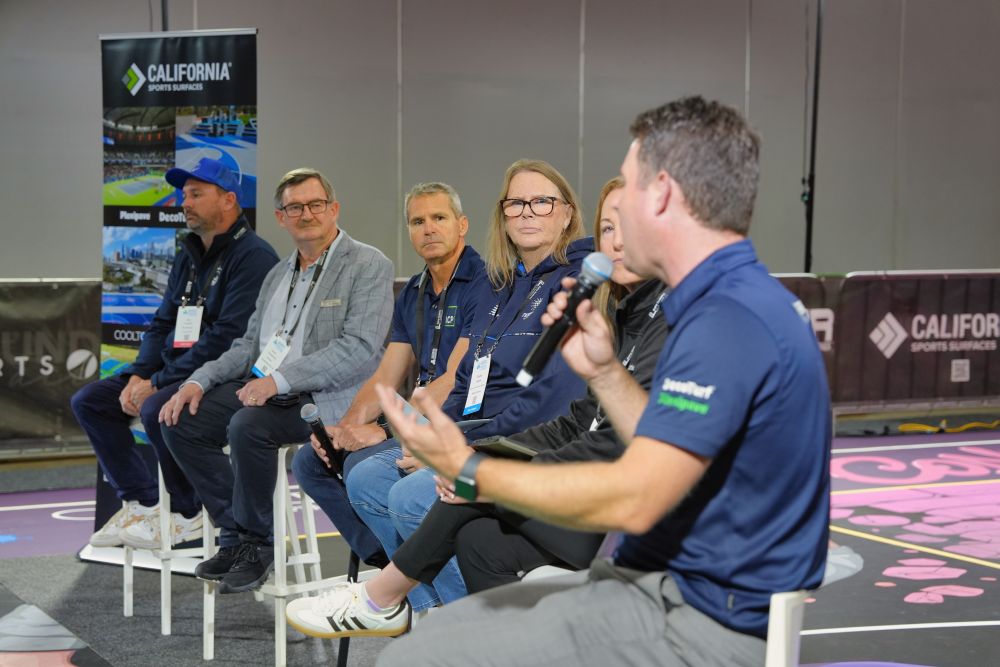
Last month, we hosted a speaker panel at the National Sports & Physical Activity Convention in Melbourne. We brought together several voices from across the netball court supply chain – including a governing body, an independent tester, a contractor, and a manufacturer – to tackle one of the most unresolved technical issues in Australian sports facility management: slip resistance on outdoor courts.
Moderated by our own Tim Shereb, the panel took on a question the industry has argued over for more than a decade: What does the right amount of grip on an outdoor netball court actually look like?
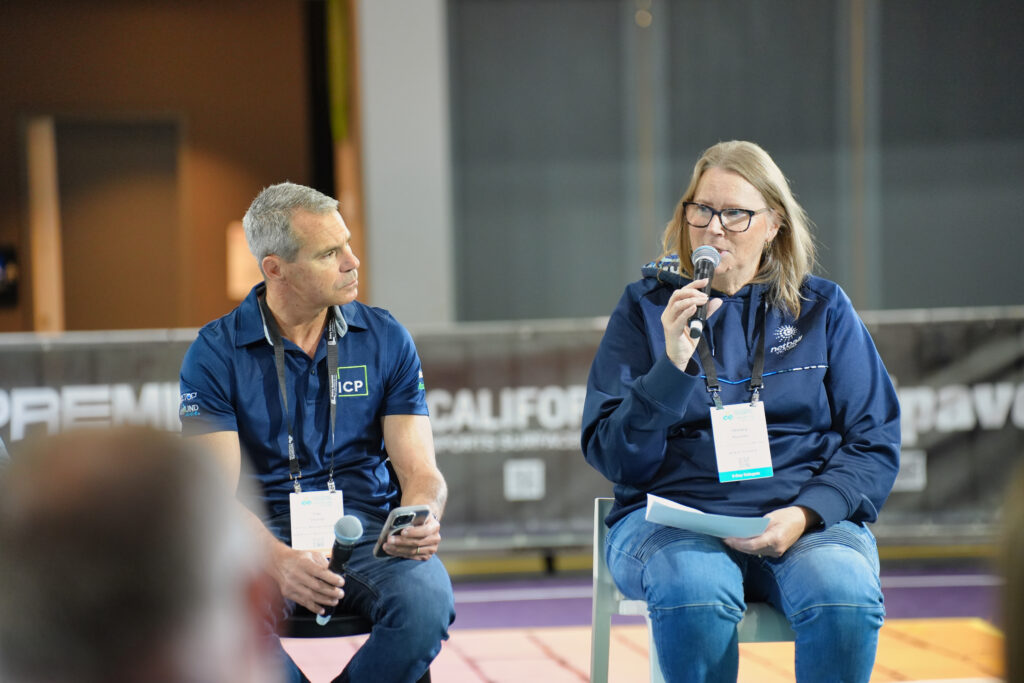
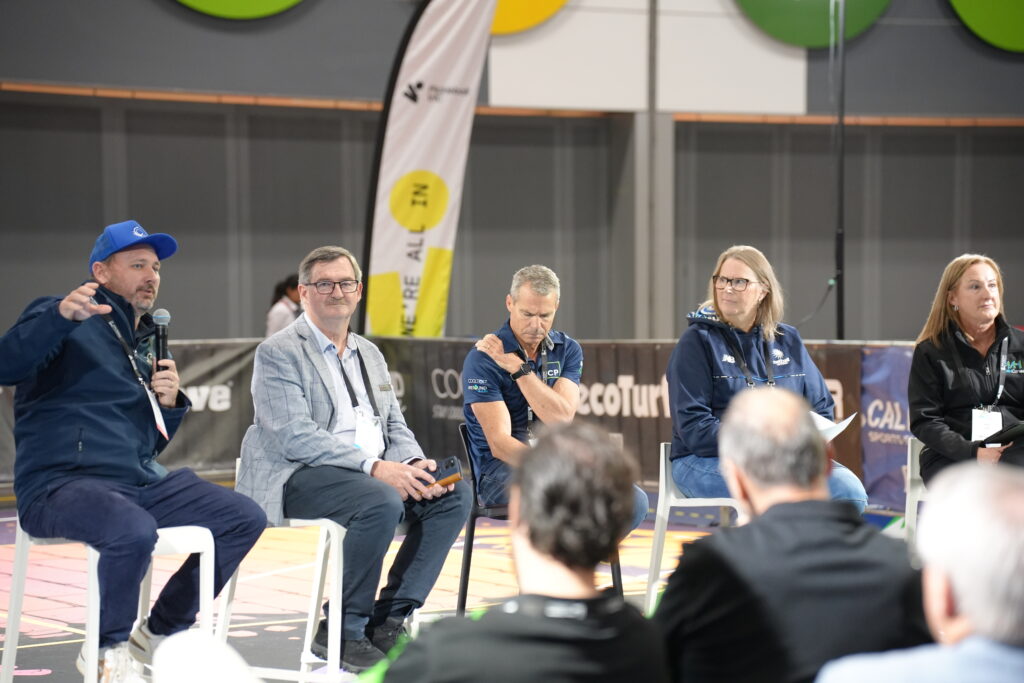
The panel brought together Shelley Hayes (Netball Victoria), Grant Humphreys (Acoustoscan, independent testing specialist), Kyle Loughlin (Court Craft, installer and advisor to Netball NSW and Netball Queensland), and our own Leon Retallick, Business Manager Australia for California Sports Surfaces and ICP Group. Between them, they cover every stage of a court’s life, from first specification to matchday.
The Problem Isn’t Just Slip
The panel opened with a reframe that shaped the rest of the conversation. As Kyle Loughlin put it, “slip” has captured the industry’s attention because slippery-court incidents are immediate and visible. But “it’s about grip, it’s about adhesion to the surface,” emphasized Kyle.
Excessive grip carries a statistically significant injury risk that rarely gets discussed:
- Too little grip causes falls.
- Too much grip locks the foot mid-pivot and transmits load straight to the knee, contributing to ACL tears that build over a career rather than a single moment.
Kyle described weekends where five ambulances were called to a single facility, three of them for blown knees. It’s a risk profile the industry has largely ignored.
Why 75 BPN Doesn’t Settle the Question
Australian outdoor netball courts must meet a 75 BPN (British Pendulum Number) minimum, but Grant Humphreys says the test itself wasn’t built for the sport. That’s because the British pendulum uses two rubber pads, one modeled on a soft running shoe, the other on a stiletto heel.
Netball testing should only use the softer pad, but the stiletto-equivalent pad is still in use, producing readings up to 10 points lower and pushing manufacturers to over-roughen surfaces to compensate.
The 75 BPN figure itself was borrowed from Netball England, adopted to Australia because the CSIRO had no netball-specific standard to reference. It was calibrated for UK courts built on porous asphalt, where water drains through during testing. Australian courts don’t drain the same way. “The water’s not getting off the surface,” he said, “so to achieve a 75, our surface needs to be much rougher and much higher.”
As Kyle pointed out, courts in Mount Isa or Townsville are all specified against the same number despite vastly different climates and drainage conditions – and a surface reading 60-65 BPN wet in Australia may be reading 75-95 BPN dry. The standard may be overstating the roughness requirement across much of the country.
The Gap Nobody Has Filled
The truth is that there’s no upper BPN limit for Australian netball courts, only the floor. Across the panel’s experience, instances of being called to a facility for being too ‘grippy’ are rare – only ever for being too slippery. That imbalance in visibility is exactly why the issue hasn’t driven regulatory change.
The research needed to fix this doesn’t exist just yet. The only global biomechanical study on netball surfaces was conducted at Wollongong University in 1988, and no netball shoe on the market has ever been tested for outdoor conditions.
Grant is pushing for an Australian outdoor standard, paired with an ISO equivalent, that can measure dynamic forces across player sizes rather than relying on a single-force test. He’s advocating for a 55 to 110 BPN range based on an overseas friction standard, but it needs Australian-specific research to validate it.
Shelley put the challenge to the room directly: “How about we get an Australian number with an Asics shoe that’s measuring the slip test, as opposed to the number that’s used at the moment?”
Where We Fit In
If there’s one thing every speaker agreed on, it’s that the industry can’t afford to keep guessing. Leon explained that this comes down to specification discipline: “We want reputable products. We want to make sure that there are reputable companies out there that can provide, and genuinely have interest in providing, things that are fit for purpose.” That’s a standard we hold ourselves to across every court we help build, from suburban netball associations to Olympic-level facilities.
With netball’s profile rising toward the 2032 Brisbane Olympics, the quality of Australian outdoor courts will be under more scrutiny than ever. As Leon put it, “People want to come to inviting areas that you want to be a part of – that’s what’s going to grow the sport. It’s got to be safe, they’ve got to be practical, they’ve got to have good design behind them.”
That shift is already underway and governing bodies are responding. Since the panel, Netball Australia has published its updated facility guidelines – including a revised compliance fact sheet and technical manual – which is a timely signal that the industry is moving forward.
We don’t have a resolved standard to hand everyone just yet, but the direction is becoming clearer. What we do have is a seat at the table, a technical team that tests in real Australian conditions, and a commitment to move this forward alongside those guidelines. Our promise is that we’ll keep bringing this conversation back until Shelley gets her wish: “Within the next five years, I challenge all of us to be on the same page.”